Campus Placement Interview Preparation: A 30-Day Plan
Jobsify AI Team · October 2, 2026
Placement season is here, and most students prepare for it the wrong way. They solve another hundred aptitude questions, polish the resume one more time, and walk into their first real interview having never said their answers out loud. This guide to campus placement interview preparation fixes that with a simple 30-day plan: what to practise, in what order, and how to use AI mock interviews without outsourcing your thinking to them.
We built parts of this plan into JobsifyAI because we kept seeing the same pattern: capable freshers losing offers in the interview room, not on the test.
Why the interview is where placements are won or lost
Getting shortlisted is only half the job. The data from this year says the other half is getting harder.
- The Unstop Talent Report 2026, based on 37,000+ students and 500+ HR leaders, found that students on campuses with 150+ visiting companies are 2.9x more likely to get placed than those on campuses with fewer than 30 recruiters.
- The same report found 26% of freshers sit on the bench for 3–6 months after joining, which tells you employers are hiring cautiously and want people who can contribute early.
- On the demand side, Xpheno data reported by People Matters on 2 September 2026 shows IT services openings at an 18-month high of about 57,000, but nearly 60% of active demand is for mid-senior and senior roles. Entry-level seats are fewer, and each one is contested.
Put simply: if your college gets 25 companies instead of 150, you get fewer interviews. You cannot afford to treat the first three as practice.
The 30-day campus placement interview preparation plan
Week 1: Know your own resume cold
Most freshers are caught out by questions about their own resume, not by tricky puzzles.
- Print your resume and write two follow-up questions next to every line. "You used React in this project. Why not plain JavaScript?"
- Prepare a 60-second answer for "Tell me about yourself" that covers who you are, one project you are proud of, and why this role.
- Remove anything you cannot defend for five minutes. A shorter honest resume beats a long padded one.
If you are not sure your resume is even getting shortlisted, run it through a resume scoring tool first. JobsifyAI's resume analysis reads the content and flags specific weak points, such as vague bullets or missing outcomes, instead of just counting keywords.
Week 2: Close the skill gaps the job description exposes
Pick three roles you will realistically apply for. For each one:
- List the skills the job description asks for.
- Mark each skill as "can explain and demonstrate", "have used once" or "never touched".
- Spend this week on the "have used once" column. That is where interview questions will hurt most.
This is what JobsifyAI's skill gap analysis does automatically: compare your resume against a target role, show the gaps, and suggest a learning path so you study what matters for that role, not everything at once. Given that AI-related postings in software development rose 138% between Q2 2024 and Q2 2026 (per the same People Matters report), expect at least one AI or data question even for non-AI roles. Be ready to explain one practical use of an AI tool in your own work.
Week 3: Mock interviews, out loud, every day
This is the week most students skip, and the one that matters most.
- Do one mock interview a day: technical on odd days, HR and behavioural on even days.
- Answer out loud. Writing answers in a notebook trains a different skill.
- Record yourself at least twice and watch it. You will notice filler words, rambling and missing structure within a minute.
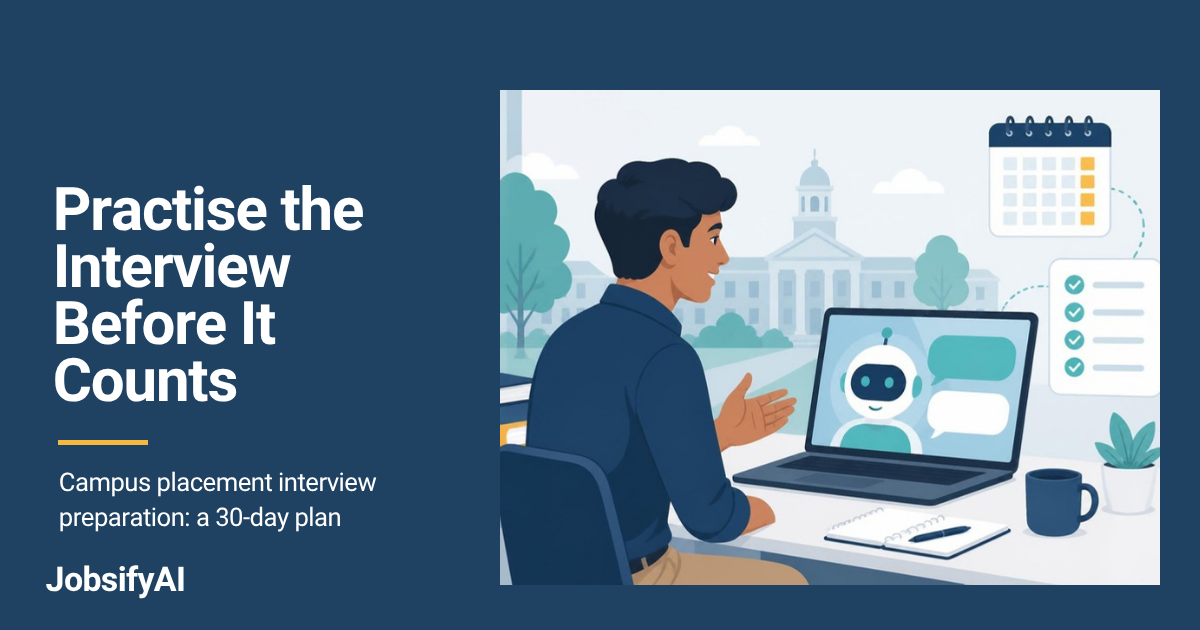
An AI mock interview is useful here because it is available at 11 p.m. the night before your drive, it does not get bored of the same question, and it lets you practise for the specific role you are targeting. JobsifyAI's mock interview practice is built for exactly this: role-focused questions you can repeat until your answers are tight.
A word of honesty: an AI mock interview is a practice partner, not a judge of your career. Use it to find weak answers, then fix them yourself. At least once this week, also do a mock with a senior, a friend or a faculty member. Human interviewers interrupt, go off-script and react to your body language. You need both.
Week 4: Company-specific polish
- Read the last year of news for each company visiting campus. Know what they build and who their customers are.
- Prepare two smart questions to ask at the end. "What does a fresher's first 90 days look like on this team?" works almost everywhere.
- Revise your top five projects using the STAR format: situation, task, action, result. Put a number in the result wherever you honestly can.
Common interview mistakes freshers make (and quick fixes)
| Mistake | Quick fix |
|---|---|
| Memorised, robotic "Tell me about yourself" | Learn the three points, not the script |
| Saying "we did" for every project | Say what you built, decided or fixed |
| Bluffing on a question you don't know | Say what you do know and how you would find the rest |
| No questions for the interviewer | Carry two prepared questions |
| Only preparing for technical rounds | Practise HR answers on salary, relocation and gaps |
What placement officers can do
If you run a placement cell, the 2.9x gap in the Unstop data is a reason to measure readiness early, not after the first drive. JobsifyAI's university product lets placement teams onboard students in bulk, assign assessments by department or batch, and see placement readiness across the whole campus in one dashboard. Students then use the same candidate tools described above.
Frequently asked questions
How early should I start campus placement interview preparation?
Start at least 30 days before your first drive. Four weeks is enough to fix resume gaps, close one or two skill gaps and do 15–20 mock interviews, which is where most improvement comes from.
Are AI mock interviews useful for freshers?
Yes, as practice. They help you rehearse answers out loud, repeat tough questions and prepare for a specific role at any hour. Pair them with at least one human mock interview, because real interviewers react in ways software does not.
What are the most common HR interview questions for freshers?
"Tell me about yourself", "Why should we hire you?", "Where do you see yourself in five years?", "Tell me about a challenge you faced in a project", and "Are you open to relocation?" Prepare short, specific answers with one real example each.
How do I prepare if my college has few companies visiting?
Treat off-campus as your main channel, not a backup. Apply on job boards such as the JobsifyAI job board, where you can apply without creating an account, and keep your resume and interview answers sharp so every shortlist counts.
Start practising today
Placement season rewards the students who have already made their mistakes in practice. Score your resume, find your skill gaps and run your first AI mock interview this week. Read our take on fresher hiring trends in 2026 for the wider market picture.