How Indian Companies Are Cutting Time-to-Hire by 60% Using AI — A Practical Guide
· June 2, 2026
How Indian Companies Are Cutting Time-to-Hire by 60% Using AI — A Practical Guide
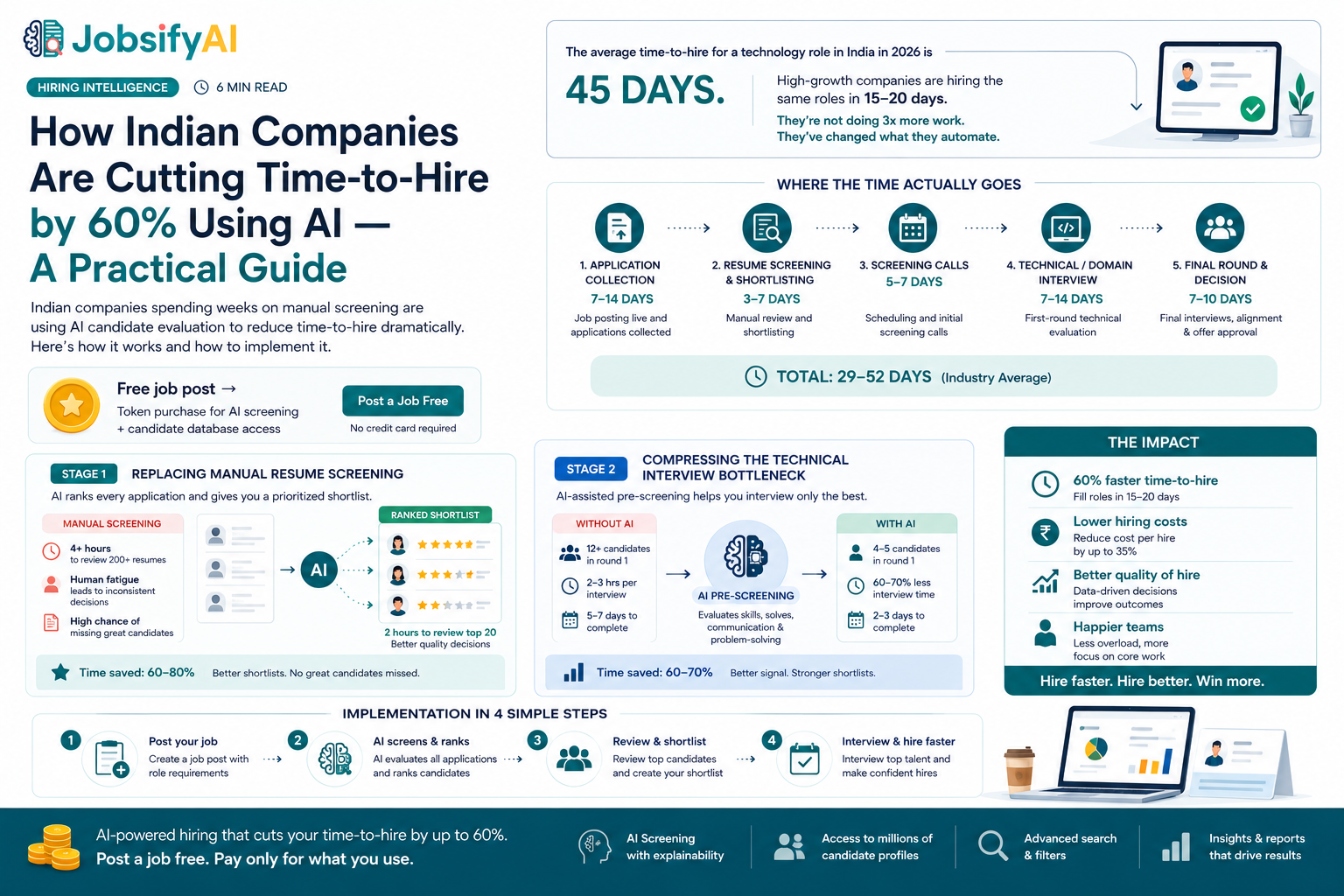
The average time-to-hire for a technology role in India in 2026 is 45 days. For a high-growth startup that needed someone three weeks ago, 45 days is a business problem. Every day that role is open, work is not getting done, team members are carrying extra load, and strong candidates are accepting offers elsewhere. The companies consistently hiring in 15–20 days for the same roles are not doing 3x more work. They have changed what they measure and what they automate. This is a practical breakdown of how they are doing it.
Where the Time Actually Goes
Before fixing anything, it is worth being precise about where your hiring time is actually being spent. Most companies have a vague sense that "screening takes too long" but cannot tell you specifically which stage is the bottleneck. In a typical Indian company hiring process for a technology role, the time breakdown looks roughly like this: Application collection period: 7–14 days. Most companies leave a role open for 1–2 weeks to collect applications before beginning screening. For urgent hires, this period alone can be compressed significantly. Resume screening and shortlisting: 3–7 days. A recruiter or hiring manager reviews applications, discards clearly irrelevant ones, and produces a shortlist. For a role that attracts 200+ applications, this is where most of the manual effort lives. Scheduling and conducting screening calls: 5–7 days. Coordinating availability between candidates and recruiters, across multiple shortlisted candidates, with the inevitable no-shows and reschedules. Technical or domain interview: 7–14 days. Getting the right interviewer available, scheduling candidates, and completing first-round technical evaluation for a shortlist of 8–12 candidates. Second round and hiring decision: 7–10 days. Final-stage interviews, internal alignment, reference checks, and offer approval. Total: 29–52 days. Which matches the industry average. The two biggest time sinks — resume screening and technical interviewing — are also the stages where AI can have the most direct impact.
Stage 1: Replacing Manual Resume Screening
Manual resume screening is the most time-consuming and the least value-adding stage of the hiring process. A recruiter spending 4 hours reviewing 200 resumes is not adding judgement to 200 candidates. They are executing a pattern-matching task at human speed that software can execute in seconds. The shift: replace manual screening with AI-ranked shortlists. An AI-powered screening system takes the job requirements, evaluates every application against them, and produces a ranked shortlist — not just a pass/fail filter, but a ranked ordering based on role fit, skill match, experience relevance, and other configurable factors. The recruiter's job changes from "read 200 resumes" to "review the top 20 ranked candidates and decide which 10 to call." This is a 2-hour task, not a 4-hour task. More importantly, it is a higher-quality task — the recruiter is making nuanced decisions on pre-qualified candidates, not spending cognitive energy on screening out obvious mismatches. What to look for in an AI screening system for India: The system should evaluate candidates against role archetypes, not just keyword lists. India's candidates often have non-standard titles and career paths. A keyword filter misses them. A role-archetype model surfaces them. The system should be configurable for your specific requirements without needing technical expertise. You should be able to adjust the weighting of skills, experience, and education based on what actually matters for your role — not just accept a generic algorithm. The system should show its reasoning. A ranking with no explanation is not useful. You need to be able to see why a candidate ranked where they did, so you can make informed decisions about whether to agree with the ranking.
Stage 2: Compressing the Technical Interview Bottleneck
Technical interviewing is the stage where most growing Indian companies hit their ceiling. The team that needs to interview candidates is also the team doing the actual work. Interview availability is scarce. Scheduling takes days. First-round interviews for 12 candidates across 3 interviewers takes a week of coordination and 2–3 hours of interviewer time each. There are two approaches to compressing this. Approach A: AI-assisted pre-screening Before any live technical interview, candidates complete a structured pre-screening assessment — technical questions, coding problems, or scenario-based responses depending on the role. This is reviewed by an AI system that evaluates the quality and depth of responses, and produces a score and summary for each candidate. The recruiter reviews these summaries and takes only the top candidates forward to live technical interviews. Instead of interviewing 12 candidates in round 1, the team interviews 4–5 — the ones who demonstrated sufficient depth in the pre-screening. This cuts first-round interview time by 60–70% while improving the quality of the candidates who reach that stage. Approach B: AI video interviews for first-round assessment Candidates record video responses to structured interview questions on their own time. An AI system analyses communication quality, technical accuracy, response structure, and confidence indicators — and produces an evaluation summary. The hiring team reviews summaries rather than watching full videos. A 45-minute interview assessment can be reviewed as a 5-minute summary. Scheduling disappears as a bottleneck entirely — candidates complete the assessment when it suits them, within a set deadline. This approach is particularly effective for roles where communication quality is a key requirement alongside technical skills, and for high-volume hiring where live first-round interviews are not operationally feasible.
Stage 3: Smarter Scheduling for Stages That Cannot Be Automated
Not every interview can or should be replaced by AI assessment. Final-stage interviews, hiring manager conversations, and senior role evaluations require human interaction. But the scheduling overhead for these stages can be dramatically reduced. The most effective change: eliminate the email back-and-forth by using calendar-based scheduling links shared directly with candidates. Candidates choose their slot from available windows rather than negotiating availability through a recruiter. This saves 2–3 days of scheduling per candidate. Combined with AI pre-screening that reduces the number of candidates reaching live interview stages, the total scheduling overhead in a compressed hiring process can be reduced by 50–70%.
Stage 4: Parallel Processing Instead of Sequential Gates
Most Indian company hiring processes are sequential: application → screening → shortlist → schedule calls → schedule interviews → decision. Each stage does not begin until the previous one is complete. Faster-hiring companies run stages in parallel wherever possible. While applications are still being collected, begin AI screening on those already received. Do not wait until the application window closes to start evaluating. While screening calls are being scheduled, have the technical assessment ready to send immediately after the call confirms interest. Do not make candidates wait a week between stages. While technical interviews are in progress, begin reference-checking on candidates who performed well in screening. Do not stack this at the end. Parallel processing can compress the total timeline by 7–14 days simply by eliminating the wait time between sequential stages — without adding any resources.
What the Numbers Look Like
A company that implements AI-ranked shortlisting, AI video pre-screening for first-round assessment, calendar-link scheduling, and parallel processing achieves approximately:
Total time saved: 15–25 days on a 45-day process. That is a 33–55% reduction without adding headcount, without lowering standards, and without the rushed decisions that come from the urgency of a role being open too long.
The Quality Improvement You Do Not Expect
Time-to-hire is the headline metric. But the quality improvement from AI-assisted screening often matters more in the long run. When a recruiter manually screens 200 resumes under time pressure, they apply heuristics that introduce bias and inconsistency. College brand. Familiar company names. A quick read that privileges well-formatted resumes over substantive content. An AI screening system applies the same criteria consistently across every candidate. It does not get tired. It does not make different decisions at the beginning and end of a screening session. It does not favour candidates from the same college as the hiring manager. This consistency tends to surface candidates that manual screening misses — particularly strong candidates from non-elite colleges, career changers with transferable skills, and candidates from Tier 2 and Tier 3 cities who have less polish but genuine capability. Companies that have implemented AI screening consistently report that their shortlisted candidates look different from what manual screening produced — and that the hire quality over time has improved.
How JobsifyAI Helps
JobsifyAI gives Indian companies the screening infrastructure that used to require enterprise budgets. Post a role and the platform immediately begins evaluating incoming applications against your requirements — using role archetype modelling rather than keyword lists, so you see strong candidates that basic ATS would miss. The candidate database of 19,000+ pre-assessed profiles gives you the option to proactively search for candidates rather than waiting for applications. Every profile in the database has an employability score, skill gap analysis, and role fit data — so your search starts with evaluated candidates, not just CVs. Your first role is free. With tokens, you access full candidate profiles, AI screening for subsequent roles, and AI video interview capabilities. The companies consistently beating their industry's average time-to-hire are not working harder. They are using better infrastructure. → Post your first role at www.jobsify.ai/employers