
Nobody Teaches You How Hiring Actually Works (And That's Why You're Getting Rejected)
· June 1, 2026
Nobody Teaches You How Hiring Actually Works (And That's Why You're Getting Rejected)
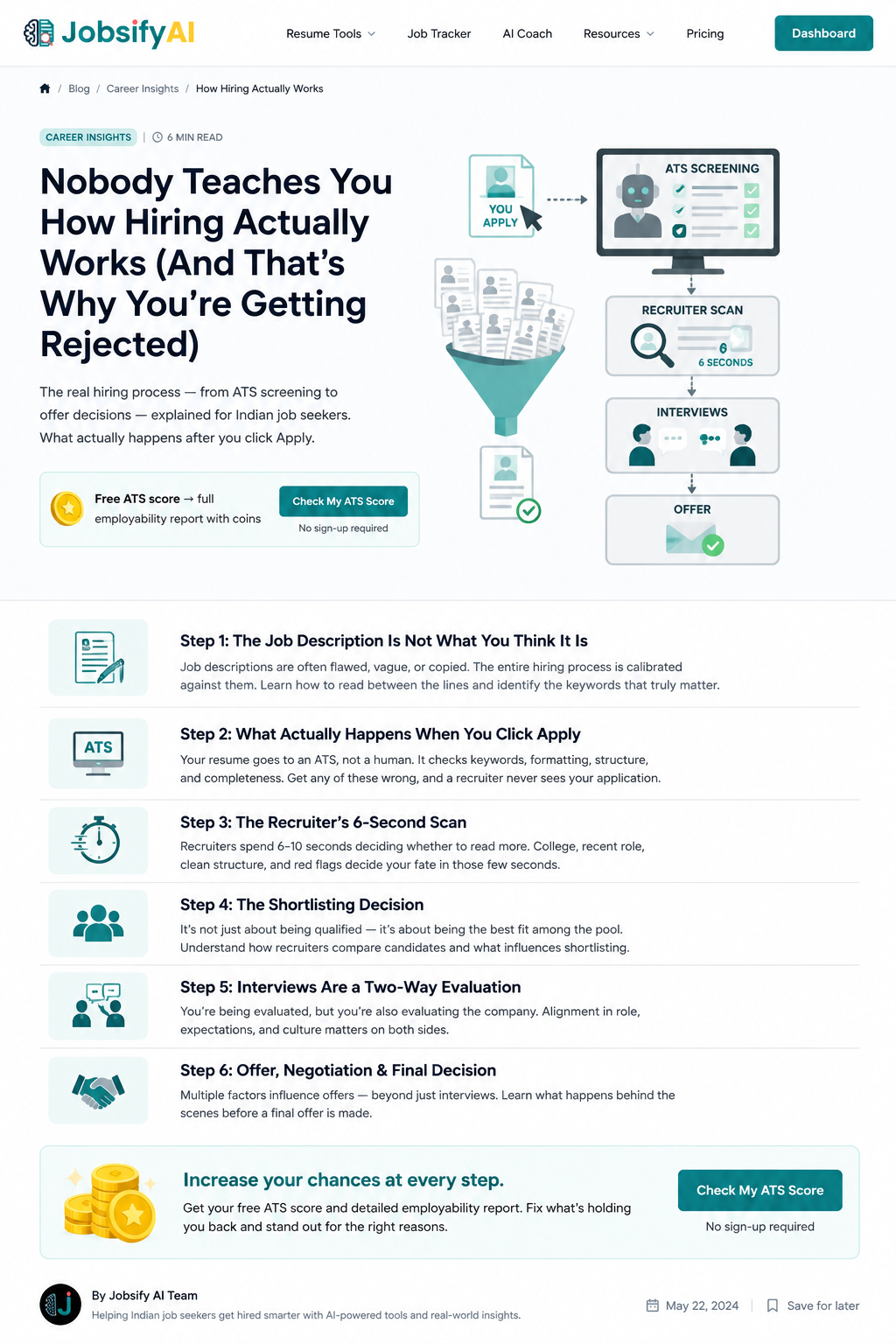
There is a version of the hiring process that most job seekers believe in. You apply. A recruiter reads your resume. They like what they see. They call you. You interview. You get the job. This version is almost entirely wrong. And the gap between what you think happens and what actually happens is responsible for most of the rejections you cannot explain. Here is the real process — step by step, from both sides of the screen.
Step 1: The Job Description Is Not What You Think It Is
Before you ever see a job posting, something important has already happened: someone wrote a job description that may not accurately reflect what the company actually needs. This matters because everything downstream — the ATS, the keyword filter, the recruiter's scan — is calibrated against the JD. If the JD is vague, copied from another company, or written by an HR generalist who has never done the job, the entire screening process is filtering for the wrong things from the start. In India, where a significant proportion of job postings come from mid-sized companies without dedicated HR infrastructure, JD quality is inconsistent. Some postings are precise and role-specific. Others are lists of aspirational skills assembled from three different job descriptions found online. Understanding this changes how you read a job posting. The keywords that appear most frequently — and most specifically — are the ones that matter. The generic phrases ("strong communication skills," "team player," "fast learner") can be ignored. The specific tools, frameworks, and role-specific requirements are what the screening system is actually checking for.
Step 2: What Actually Happens When You Click Apply
Here is the moment most candidates misunderstand. When you submit an application — through a company portal, LinkedIn, Naukri, or any job board — your resume does not go into a recruiter's inbox. It goes into an Applicant Tracking System. An ATS. The ATS is software. It does not read. It parses. It converts your resume into structured data — name, contact, education, experience, skills — and then scores that data against the criteria set for the role. Most large companies in India, and an increasing number of mid-sized ones, have some form of ATS. Even if they do not have a formal enterprise ATS like Workday or Greenhouse, they are likely using the built-in screening tools on Naukri, LinkedIn, or Indeed that perform essentially the same function. What the ATS is checking: Keywords. Does your resume contain the specific words from the job description? Not synonyms — the exact words. If the JD says "Spring Boot" and you wrote "Java backend framework," the ATS may not register a match. Formatting. Can the ATS read your resume at all? Multi-column layouts, tables, text boxes, designed templates, and unusual fonts can all break ATS parsing. When the parsing breaks, your content becomes garbled — your skills end up in your education section, your dates appear next to random words. The ATS scores this as a poor profile. It is nothing to do with your qualifications. Section structure. The ATS expects to find specific sections — experience, education, skills — in a recognisable structure. Unusual section headings or unconventional ordering can confuse the parser. Completeness. Required fields that are missing — contact information, dates, education level — can trigger automatic filtering. If your resume does not pass the ATS, it is filtered out. A recruiter never sees it. Your qualifications are irrelevant at this point. Depending on the role and the company, somewhere between 50% and 80% of applications are filtered at this stage.
Step 3: The Recruiter's 6-Second Scan
Assume your resume passed the ATS. It now appears in a recruiter's queue — along with dozens or hundreds of others that also passed. The recruiter does not read these resumes. Not initially. They scan them. Research consistently shows that the initial recruiter review of a resume takes between 6 and 10 seconds. In that window, they are looking at a very small number of things: Where did you study? In India, college brand still carries weight — particularly for entry and early-career roles at large companies. This is neither fair nor meritocratic, but it is real. What did you do most recently? Your last or current role and company is the first data point most recruiters register. Does the structure look clean? A cluttered, hard-to-read resume gets less attention than a clean, scannable one — even if the content is identical. Is there anything obviously disqualifying? Unexplained gaps, very short tenures at multiple companies, or a role history that seems disconnected from the position can trigger a pass at this stage. If you clear the 6-second scan, the recruiter reads more carefully. If you do not, the resume goes to the rejection pile regardless of what it contains.
Step 4: The Shortlisting Decision
A recruiter working a role might receive 400 applications. After ATS filtering, they might review 80. After the quick scan, they might read 20 carefully. They will shortlist 10–15 for the next stage. This shortlisting decision is not purely about qualifications. It is about fit relative to the pool. If 5 candidates have exactly the experience required and 15 more are close, the 15 who are close are being compared against the 5 who are perfect. The bar is set by the best candidates in the pool, not by an absolute standard. This is why applying to the right roles — roles where you are genuinely competitive in the candidate pool — matters more than applying to many roles. A strong application for a role you are 85% suited for will outperform a weak application for a role where you are 95% suited, because your resume is not competing in isolation. It is competing against everyone else who applied.
Step 5: The Screening Call
The shortlisted candidates get a call. This is usually from HR or a recruiter, not the hiring manager. The purpose of this call is not to assess your qualifications in depth. It is to verify basic facts and filter for obvious mismatches. Common screening call questions:
Current CTC and expected CTC Notice period Location preference / willingness to relocate Basic confirmation of the experience on your resume Sometimes: a first-pass assessment of communication
Many candidates are filtered out at this stage not because of their qualifications but because of a CTC mismatch, a notice period that does not work for the company's timeline, or communication that raises concerns. Being clear, confident, and specific on a screening call — not rambling, not underselling yourself, not being vague about your expectations — significantly improves your conversion rate from shortlist to interview.
Step 6: The Technical or Domain Interview
This is where actual assessment happens. Depending on the role, this might be a technical interview (coding problems, system design, domain knowledge), a case study or work sample exercise, or a structured competency interview. The key thing most candidates miss: the interviewer is not just evaluating whether you know the right answer. They are evaluating how you think, how you communicate under pressure, whether you can structure and explain your reasoning, and how you respond when you do not know something. A candidate who clearly explains their thought process while arriving at a wrong answer often scores better than a candidate who gives the right answer with no explanation. Because the company is not hiring an answer — they are hiring a person who will solve problems they have not encountered yet.
Step 7: The Decision You Do Not See
After the interview, there is usually a discussion that you are not part of. Interviewers compare notes. They assess the candidate relative to others they have spoken to. They factor in team dynamics, current skill gaps, and sometimes budget constraints. Candidates who do not get offers frequently have no idea what the deciding factor was. It may have been a genuine skill gap. It may have been that another candidate had a specific tool experience the team needed urgently. It may have been timing. This is worth understanding not as a reason to feel hopeless, but as a reason not to over-personalise rejection. Many rejection decisions happen at the margins, in discussions you were never part of, for reasons you could not have predicted.
What This Means for Your Job Search
Understanding the real process changes what you should focus on. Most of your applications are being filtered before a human sees them. That means fixing your ATS score and resume formatting is not optional — it is the price of entry. The recruiter's 6-second scan is real. Clean, readable, well-structured resumes get more attention. You are always competing against a pool. Targeting roles where you are genuinely competitive matters more than volume. The screening call is an assessment of communication and expectations. Prepare for it specifically. Interviews assess thinking, not just knowledge. Practising how you explain your reasoning matters as much as practising the answers.
Know Where You Stand Before You Apply
Most candidates go through this entire process without ever knowing their ATS score, their role fit percentage, or their interview readiness level. They apply and hope. JobsifyAI shows you all of it before you apply. Your free check gives you your ATS score and top keyword gaps. With coins, you unlock your full employability report — your skill gaps for specific roles, your role fit score, and your interview readiness assessment. It is the information you need before you spend weeks applying to roles where the filter has already decided against you. → Start your free check at www.jobsify.ai