
The Complete Guide to ATS in India 2026: What Every Job Seeker Must Know
· June 1, 2026
The Complete Guide to ATS in India 2026: What Every Job Seeker Must Know
If you are applying for jobs in India and not getting callbacks, the most likely explanation is something you cannot see, were never told about, and almost certainly did not learn in college. It is called an ATS — Applicant Tracking System. And in 2026, it is the invisible gatekeeper between you and every job you apply to. This is the complete guide. By the end, you will understand exactly how ATS works, why it rejects good candidates, and what you need to do differently starting with your next application.
What Is an ATS?
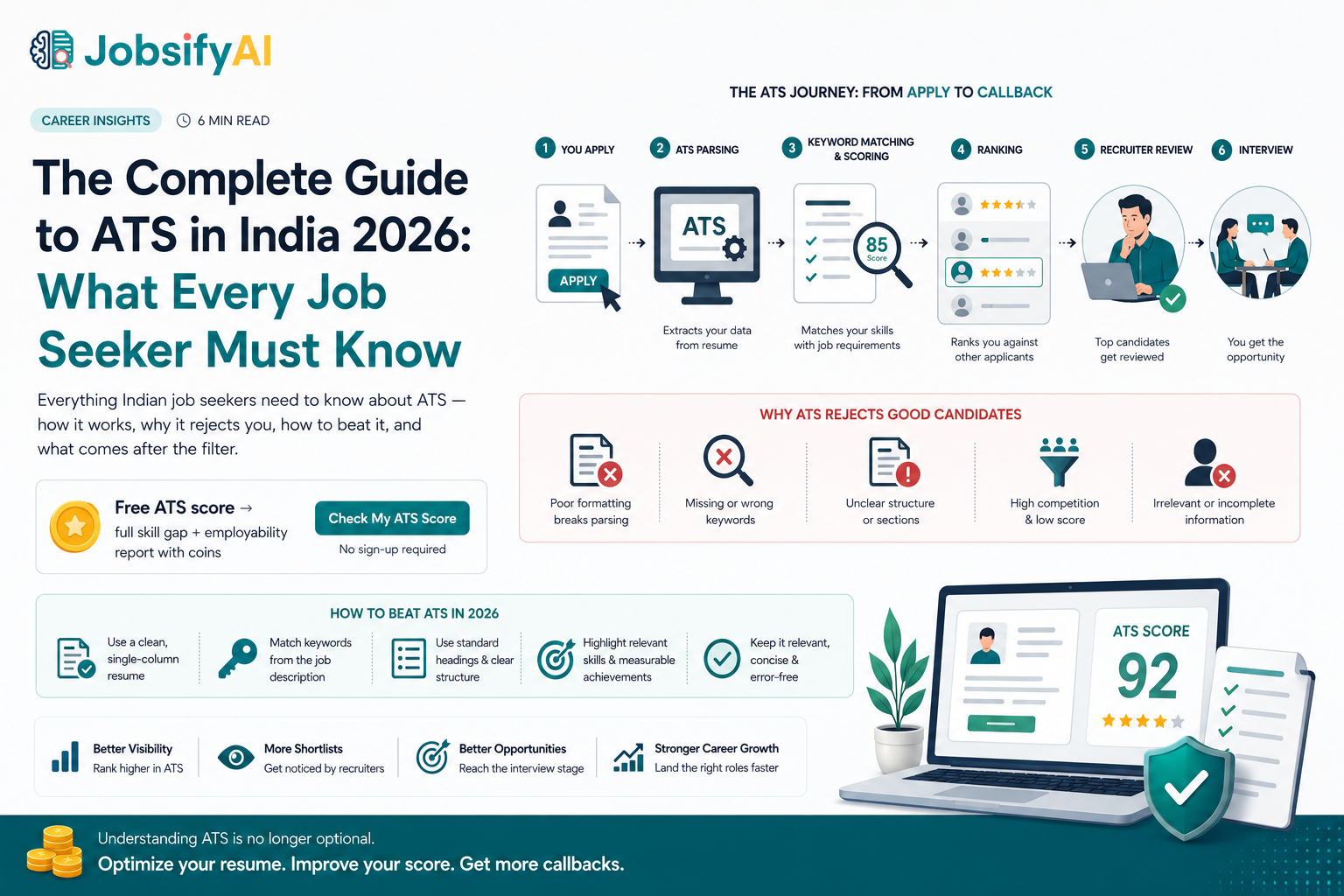
An Applicant Tracking System is software that companies use to manage job applications. Every time you apply for a role at a company with more than 50 employees — and at many smaller ones — your application is processed by an ATS before any human sees it. The ATS does several things: It receives your resume and parses it — converting your formatted document into structured data. Name, contact information, education, work experience, skills — all extracted and stored in a database. It scores your parsed resume against the requirements for the role. How well do your skills match the job description? Do the keywords align? Is your experience relevant? It ranks you against other applicants. Your application sits in a queue with everyone else who applied, ordered by score. It surfaces the top candidates to the recruiter. The recruiter sees a ranked shortlist — not all 400 applications. They start from the top and work down. If you do not appear in the top portion of that ranked list, there is a strong chance no human ever reviews your application. You receive a generic rejection email — or nothing at all. This is the process that most job seekers in India have no idea is happening.
Which Companies Use ATS in India?
Almost all large companies, most mid-sized companies, and an increasing number of smaller companies use some form of ATS. This includes all major IT services companies (TCS, Infosys, Wipro, Accenture, Cognizant and others), BFSI companies, healthcare organisations, retail chains, manufacturing firms, and any company that receives more than 50-100 applications per role. Beyond dedicated ATS software, most job boards have built-in screening functionality that operates on similar principles. When you apply through Naukri, LinkedIn, Indeed, or Shine, the platform's own matching algorithms filter and rank your application before a recruiter reviews it. The specific mechanics differ but the underlying principle is the same: automated screening before human review. Practically speaking: if you are applying to any structured organisation in India, assume ATS is in the process.
How ATS Parsing Works — And Where It Breaks
The ATS's first task is to parse your resume — convert it from a formatted document into structured data. This is where many Indian job seekers run into their first problem. Parsing works best with plain, clean, consistently structured documents. It breaks with complex formatting. Multi-column layouts are one of the most common parsing failures. The ATS reads left to right in a single pass. A two-column resume is read as one continuous stream — so your right-column content ends up mixed in with your left-column content. The result is a garbled profile that the ATS cannot make sense of. Tables have the same problem. Content inside a table is often missed entirely or scrambled during parsing. Text boxes — used frequently in designed resume templates — are often skipped by parsers. Anything you put in a text box may not be read at all. Headers and footers — if your contact information is in the document header, some ATS systems will not extract it correctly. Graphics and icons — skill bars showing "Python — 80%", icons, charts, and images contain no extractable text. The ATS sees nothing where you put a visual element. Unusual fonts can cause character recognition errors. Standard fonts (Calibri, Arial, Times New Roman, Georgia) are safe. Decorative or display fonts may produce extraction errors. PDF formatting — while most modern ATS systems handle PDFs well, some older systems still process Word documents more reliably. When in doubt, submit a clean, standard-formatted .docx or PDF. The single most reliable formatting choice for ATS compatibility: a single-column document in a standard font with clearly labelled sections using straightforward headings. It will look plain. It will parse cleanly.
How ATS Keyword Scoring Works
Once your resume is parsed, the ATS scores it for relevance to the role. The primary mechanism for this scoring is keyword matching. The ATS compares the text of your resume against the text of the job description. It looks for matches — specifically for the words and phrases the job description uses to describe required skills, tools, qualifications, and experience. Exact matching is the most common approach in basic ATS systems. "Spring Boot" in the JD, "Spring Boot" in your resume — match. "Spring Boot" in the JD, "Java microservices" in your resume — no match, even if they refer to the same capability. Proximity and frequency also matter in many systems. Keywords that appear multiple times in your resume score higher than those that appear once. Keywords that appear in prominent sections (skills, experience, summary) often score higher than those buried in project descriptions. Required versus preferred qualifications — many JDs distinguish between must-have and nice-to-have. ATS systems configured carefully will weight these differently. Missing a required keyword has more impact than missing a preferred one. The practical implication: read the job description carefully before you apply. Identify the specific words and phrases used for required skills and qualifications. Make sure those exact words appear in your resume — in your skills section, your work experience, and your summary where relevant.
Why Good Candidates Get Rejected by ATS
Understanding the mechanics explains why ATS rejection is not a fair assessment of your capability. You used synonyms. Your resume says "client relationship management" and the JD says "CRM." The system may not connect them. Use the exact terminology from the JD. Your resume format broke the parser. Everything you wrote was correct, but the multi-column template you used scrambled the extraction. The ATS saw incoherent text and scored it poorly. You tailored too lightly. You sent the same resume to 30 different roles. Each role's JD uses different language. Your generic resume matches none of them well enough. Your career path is non-linear. You transitioned industries, have a non-standard title, or acquired skills through non-traditional routes. The ATS is looking for expected keywords and patterns. Your actual capability is not reflected in the keywords it is searching for. The JD was poorly written. A vague, generic, or keyword-loaded JD produces a poorly calibrated scoring model. Candidates who are genuinely qualified may score poorly against it while candidates who have gaming the system score well.
How to Improve Your ATS Score
- Use a single-column, clean format No tables, no columns, no text boxes, no graphics. Standard font. Clearly labelled sections. This eliminates formatting-based parsing failures entirely.
- Mirror the JD's language Read the job description. List every specific tool, technology, qualification, and skill mentioned. Make sure each one that applies to you appears in your resume using the same words. Do not paraphrase.
- Build a strong skills section Create a clearly labelled Skills section near the top of your resume. List technical skills, tools, frameworks, certifications, and domain-specific expertise in plain text. This is one of the most-weighted sections in ATS evaluation.
- Tailor for each application Your base resume stays the same. Before each application, spend 10–15 minutes adjusting your skills section and professional summary to reflect the specific language of that JD. A tailored application outperforms a generic one significantly.
- Write a specific professional summary Replace the generic objective statement ("seeking a challenging role…") with two to three sentences that include your target role title, your key skills using industry-standard terminology, and your level of experience. This is keyword-dense content that scores well.
- Check your score before you apply You do not have to guess whether your resume is ATS-optimised. JobsifyAI provides a free ATS score at jobsify.ai — paste your resume and the job description, and the platform shows you your keyword match score, what is missing, and what to fix. It takes two minutes and it changes how you apply.
What Happens After You Pass the ATS
Clearing the ATS is the first filter. It is not the only one. After the ATS produces a shortlist, a recruiter reviews the top candidates. This review is fast — 6 to 10 seconds per resume initially. Clean, well-structured, readable resumes get more attention in this scan. If you clear the recruiter scan, there is typically a brief screening call — which checks for salary expectations, notice period, and basic communication quality — before any technical or in-depth interview. Understanding the full sequence helps you optimise for each stage, not just the first one. Your ATS score gets you seen. Your resume quality gets you to the screening call. Your interview readiness gets you to the offer.
ATS Is the Beginning, Not the End
Most job-search tools stop at ATS. They show you your keyword score and leave you to figure out the rest. The deeper question — am I genuinely positioned for the roles I am applying to? What skills am I missing? Am I interview-ready? — goes unanswered. This is the gap JobsifyAI was built to close. Your free check gives you your ATS score and the specific keywords your resume is missing. With coins, you unlock the full employability report — your exact skill gaps for the roles you are targeting, your role fit score, and your interview readiness assessment. The complete picture of where you stand, not just whether you passed one filter. Because the goal is not to pass the ATS. The goal is to get the job. And getting the job requires knowing your actual position — before you apply. → Check your free ATS score at www.jobsify.ai