The Skills Indian Companies Are Actually Hiring For in 2026 (Not What Job Descriptions Say)
· June 2, 2026
The Skills Indian Companies Are Actually Hiring For in 2026 (Not What Job Descriptions Say)
There is a frustrating gap between what Indian job descriptions say companies want and what actually gets candidates hired. Job descriptions in India frequently list 20 required skills, including five that are rarely tested, three that are outdated, and two that the hiring team themselves could not define precisely. Candidates read these lists, feel overwhelmed, and either apply anyway or spend months upskilling in the wrong direction. What follows is a more honest picture — based on what Indian hiring patterns in 2026 are actually signalling, not what templated JDs say. This matters because knowing where the real demand is changes how you spend your development time.
How to Read This List
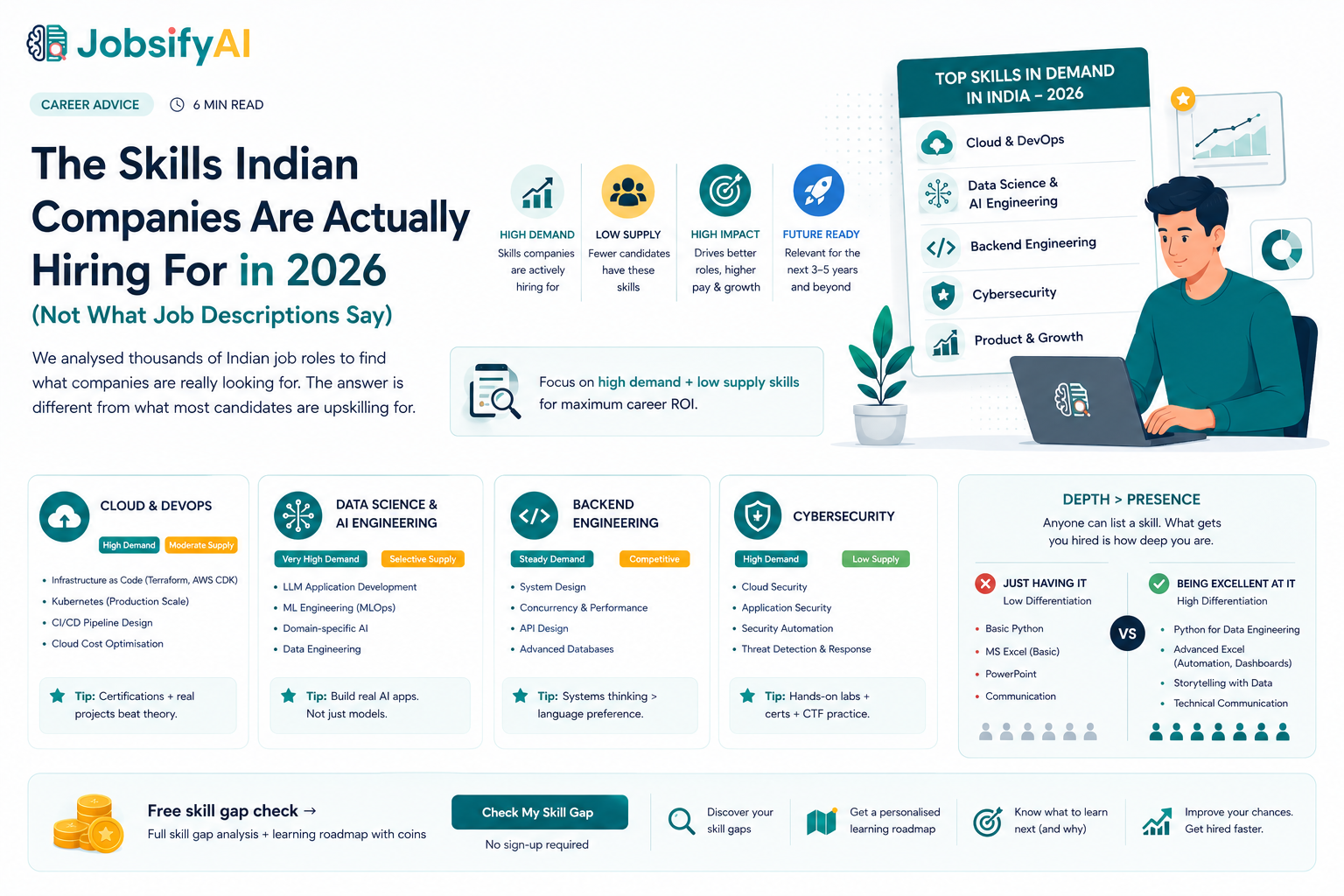
Before the sectors: a note on how to use this. Every skill listed here has two dimensions that matter for your career decisions. The first is demand — how many roles are asking for it right now. The second is supply — how many candidates have it. The best skills to develop are high demand and low supply, because that is where the hiring market rewards you most. A skill can be in high demand but low ROI if every candidate already has it. Basic Python is an example — yes, it is in demand, but so many candidates now list Python that having it alone does not differentiate you. The depth of your Python skill matters more than the fact that you have it. This distinction — depth versus presence — is one of the most underappreciated dimensions of the Indian job market in 2026.
Technology Roles
Cloud and DevOps (High Demand, Moderate Supply)
Cloud skills — specifically AWS, Azure, and GCP — have been growing in Indian job demand for several years. What is new in 2026 is that demand has shifted from basic cloud familiarity to applied cloud operations. Companies are no longer looking for candidates who have done the AWS certification. They are looking for candidates who can build, manage, and troubleshoot cloud infrastructure in production environments. The certification is now a baseline, not a differentiator. Specific skills in high demand and relatively low supply:
For candidates: cloud certifications are worth getting, but pair each certification with a practical project that demonstrates you can actually use the skills in a real environment.
Data Science and AI Engineering (Very High Demand, Selective Supply)
Data science has been overhyped and under-specified for several years in India. In 2026, the market is becoming more precise about what it actually needs. Generic data science — building models, running analyses, visualising data — is competitive. There are more candidates with these skills than there are mid-level roles. The market is crowded at the generalist level.
What is in genuine short supply:
For candidates transitioning into AI: the most accessible entry point is learning to work with existing LLM APIs and build applications on top of them. This requires less mathematical depth than traditional ML and is in high demand.
Backend Engineering (Steady Demand, Competitive)
Backend engineering demand in India remains strong but the market is competitive. The differentiation in 2026 comes less from which language you know and more from systems thinking. What separates shortlisted candidates from filtered-out ones in backend roles:
Java (Spring Boot) and Python (FastAPI/Django) are the most common backend stacks in India's market. Node.js has significant demand in startups. Golang is growing, particularly in companies building high-performance services.
Cybersecurity (High Demand, Low Supply)
Cybersecurity is one of the clearest high-demand, low-supply situations in India's tech job market. Companies across sectors are hiring security professionals but the talent pool is thin. Areas with the strongest demand:
For candidates: cybersecurity is one of the better directions to invest development time in 2026. The demand is real, the supply is low, and the salary premium is significant.
Non-Technology Roles
The skills shift in India is not limited to technology. Across business functions, the market is rewarding specific capabilities that were less emphasised in previous years. Data Literacy Across Functions Every function — sales, marketing, operations, finance, HR — is now expected to work with data. But what companies actually need is more specific than "data skills." The skill that is genuinely short in supply across non-tech functions is the ability to move from data to decision: identifying the right question to ask, pulling and cleaning the relevant data, and presenting a clear, actionable conclusion to stakeholders. Many candidates can run reports. Fewer can construct the analysis that answers a business question from scratch. For candidates in non-tech roles: proficiency in SQL for data extraction, combined with strong analytical thinking and clear communication, is a combination that is in demand and differentiates candidates meaningfully. Communication Depth (Underrated, High Impact) This is consistently underestimated by Indian candidates, particularly for roles that involve client interaction, cross-functional work, or stakeholder management. The communication capability that companies are actually looking for is not fluent English. It is the ability to structure thinking clearly, explain technical or complex concepts to non-specialists, and write clearly — in emails, documents, and presentations — without producing verbose, jargon-heavy content. Senior roles in product management, consulting, business development, and client-facing positions filter heavily for this. Candidates who can communicate with clarity and precision at a senior level are in genuinely short supply relative to demand. Product Thinking in Technology Roles For technology candidates targeting product management, or senior engineering roles that interact with product teams, the ability to think in terms of user problems and business outcomes — not just technical requirements — has become a meaningful differentiator. Companies in startups and product organisations are looking for engineers and PMs who can go from a business problem to a specification to a solution, not just implement a specification they were handed. This combines domain understanding, customer empathy, and technical clarity in a way that many candidates have not developed.
What This Means for Your Skill Development
Reading a list of in-demand skills is useful context. Acting on it requires knowing where your personal gap is — relative to the specific roles you are targeting. Spending time on a skill that is in demand generally but that you are already strong in has limited ROI. Spending time on a skill that is specifically missing from your profile for your target roles has high ROI. This is the difference between generic upskilling and targeted skill gap closure. Generic upskilling: "Cloud skills are in demand, I will do an AWS certification." Targeted gap closure: "I am applying for DevOps roles at mid-sized tech companies. My profile shows strong Linux and scripting skills but no Kubernetes or Terraform experience. My role fit score for the roles I want is 68%. Closing the Kubernetes gap specifically would move me to approximately 82% fit." The second approach requires knowing your actual gap — not guessing based on a general list.
Know Your Actual Skill Position
JobsifyAI analyses your profile against your target roles and gives you your specific skill gap — not a general list of what the market wants, but a precise map of what you are missing for the roles you actually want to get. Your free check gives you your top keyword gaps and ATS score. With coins, you unlock the full skill gap analysis — your role fit score against specific target roles, the exact skills you are missing, and a prioritised view of which gaps to close first based on hiring demand. Not general career advice. Your specific gap, for your specific targets. The candidates getting hired in India's competitive market in 2026 are not necessarily the ones who worked hardest. They are the ones who worked on the right things. Knowing your actual gap is the first step to working on the right things. → Find your skill gaps at www.jobsify.ai