Why Most "AI Hiring Tools" Are Just Automation — And What Real AI Hiring Looks Like
· June 1, 2026
Why Most "AI Hiring Tools" Are Just Automation — And What Real AI Hiring Looks Like
The word "AI" appears in almost every recruitment platform's marketing today. Your ATS says it uses AI. The job board says it uses AI. The resume screening tool says it uses AI. The interview scheduling software says it uses AI. Most of them are not lying. But most of them are also not doing what most people imagine when they hear the word. Understanding the difference is important — both for companies choosing hiring tools and for candidates trying to understand why the tools keep getting them wrong.
What Automation Actually Means in Hiring
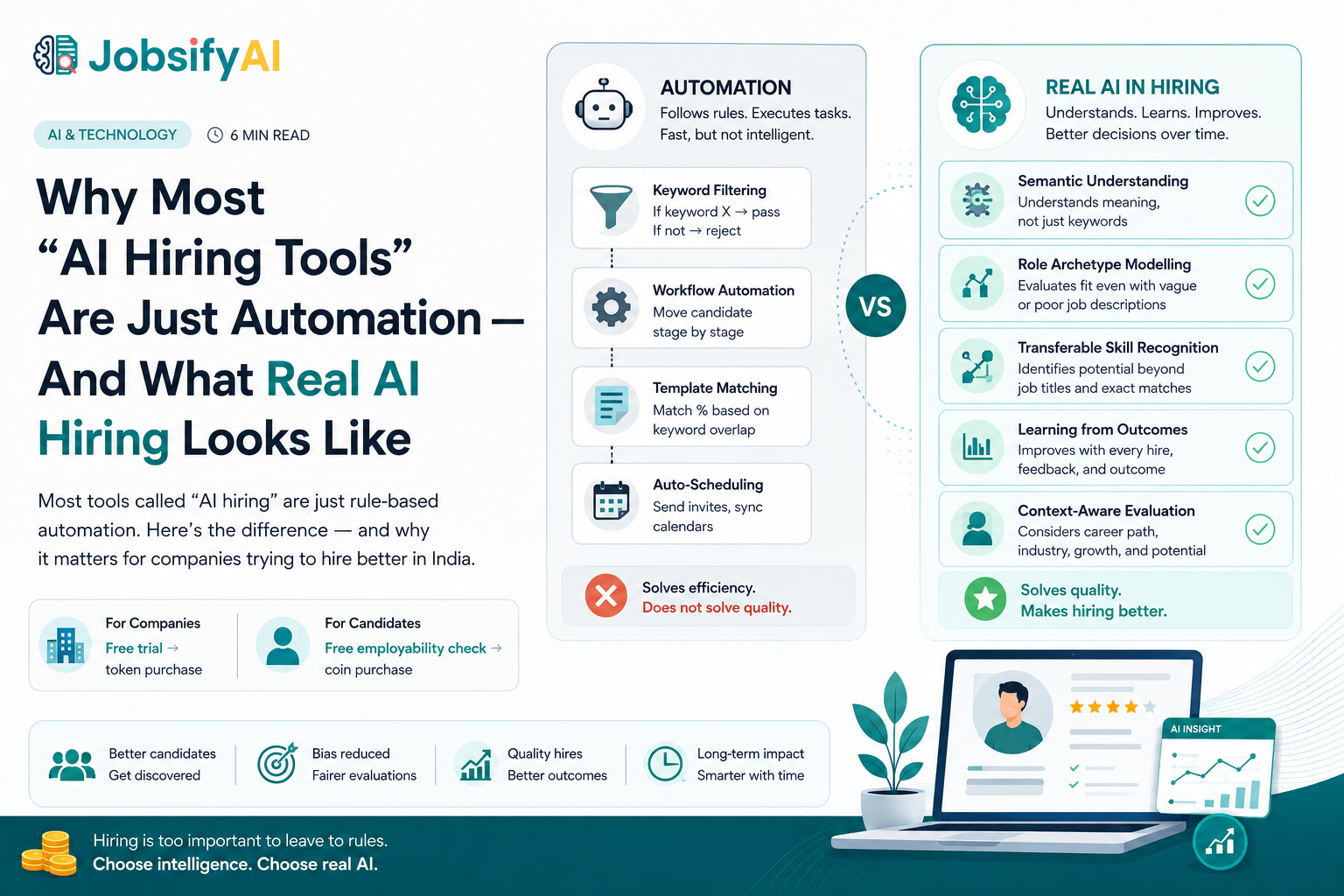
Let's be precise about what most "AI hiring tools" are actually doing. Rule-based filtering is not AI. It is a set of conditions: if the resume contains keyword X, pass it; if not, filter it out. This is the same logic as an Excel IF statement. It is useful. It scales. But it is not intelligent. It cannot learn from outcomes, adapt to context, or recognise capability that was not explicitly defined in the rules. Workflow automation is not AI. Moving a candidate from "applied" to "screening" to "interview" to "offer" automatically based on triggers is process management. It saves time and reduces manual coordination. But it makes zero decisions about whether a candidate is a good fit. It just moves them through a pipeline faster. Template matching is not AI. Comparing a resume to a job description and producing a match percentage based on keyword overlap is pattern matching. It is faster than a human doing the same comparison, but the underlying logic is the same: does this text contain these words? Auto-scheduling is not AI. Sending an interview invitation when a candidate reaches a certain stage is a calendar integration. It is a useful feature. It is not intelligence. The vast majority of what the recruitment industry markets as "AI" is one of these four things. They are valuable features. But they are solving efficiency problems — not quality problems. They make hiring faster. They do not make it better.
Why Automation Is Not Enough for India's Hiring Reality
Automation in hiring was designed for markets with predictable inputs: standardised job descriptions, conventional career paths, clearly structured resumes, and candidates who fit neatly into defined categories. India's talent market does not look like this. A significant proportion of India's most capable candidates are self-taught. Their career paths are non-linear. Their job titles do not reflect their actual capability. Their resumes use formatting that was never designed for ATS parsing. They are applying for roles where their transferable skills are highly relevant but where their stated experience does not match the keywords in the job description. A rule-based system sees these candidates and filters them out. It cannot do anything else — it is following rules, not making judgements. At the same time, India produces a large number of candidates who have become very good at gaming rule-based systems. They know which keywords to include. They have learned how to format resumes for ATS. They have produced profiles that score well on keyword match — without necessarily having deep capability in the areas those keywords describe. The result: rule-based automation systematically excludes some of India's best candidates while allowing others through who are optimised for the filter rather than for the job. Neither outcome is what a company is actually looking for.
What Real AI in Hiring Actually Looks Like
Real AI in hiring is not faster rule-following. It is the ability to make judgements that rule-based systems cannot make — and to improve those judgements over time. Here is what that looks like in practice: Semantic understanding, not keyword matching. A system with genuine language understanding knows that "Spring Boot" and "Java microservices framework" are related — even if the exact words do not match. It knows that a candidate describing their experience with "CI/CD pipelines using Jenkins" is likely to be familiar with DevOps concepts even if they did not use that exact phrase. Keyword matching cannot do this. Language model-based evaluation can. Role archetype modelling, not JD dependency. Real AI understands that a "backend engineer" role has a consistent set of required competencies across companies — regardless of how any individual JD describes it. This means it can evaluate candidate fit even when the job description is vague, incomplete, or written poorly. It is not calibrated to the quality of a single document. It is calibrated to the actual requirements of the role. Transferable skill recognition. A support engineer who has built automation scripts, managed Linux servers, and worked with cloud infrastructure has skills directly relevant to a DevOps role — even though their title says "Support Engineer." A data analyst with strong statistical reasoning and Python skills has the foundation for a data science transition — even if they have never held the data scientist title. Real AI can identify and credit these transferable capabilities. Rule-based systems cannot. Learning from outcomes. A genuinely intelligent hiring system improves over time by learning which candidates actually performed well after being hired, and adjusting its evaluation model accordingly. It is not a static set of rules. It is a model that gets better with data. This is the component that most recruitment tools — even those that claim AI — lack. It requires access to outcome data, which means it requires deep integration with the hiring process and willingness to close the feedback loop. Multi-factor evaluation. Real AI assesses candidates across multiple dimensions simultaneously — not just keyword match, but skill depth, experience relevance, learning potential, communication quality, and role fit — and produces a composite evaluation that reflects how a human expert would assess the candidate, not how a rule set would filter them.
The Difference in Practice
Consider two candidates applying for a data analyst role at an Indian fintech company. Candidate A has five years of experience at a well-known analytics firm. Their resume uses all the right keywords. Their ATS score is excellent. A rule-based system shortlists them immediately. Candidate B has three years of experience, including a year and a half in a support role. Their resume does not use standard data analyst terminology. But they have built automated reporting systems, worked extensively with SQL and Python, and have demonstrable analytical problem-solving capability documented in their project descriptions. A rule-based system filters them out based on keyword mismatch and the support role experience. A real AI evaluation of both candidates might reveal that Candidate A's experience, while broad, is relatively shallow — they have done the same types of analysis repeatedly without deepening into more complex modelling. Candidate B, despite the non-linear path, shows higher learning velocity, more genuine problem-solving depth, and better fit for the specific challenges this role requires. A rule-based system will never surface this insight. It will shortlist Candidate A and reject Candidate B every time.
Why This Matters for Candidates
If you are a job seeker in India, this distinction matters directly. If the tools being used to evaluate your application are rule-based, optimising your resume for those rules is a legitimate strategy. Understanding ATS, including the right keywords, and formatting your resume correctly will improve your results in a rule-based system. But rule-based optimisation has a ceiling. You can get better at passing filters. You cannot get a rule-based system to understand your actual capabilities if they are not expressed in the terms the rule expects. This is why the deeper question — not "did I pass the ATS?" but "am I genuinely a fit for this role, and do I understand my actual skill position?" — matters more in the long run. Understanding your real employability — your role fit score, your skill gaps, your interview readiness — is the foundation of a job search that produces consistent results. Not just one that occasionally tricks a filter.
What JobsifyAI Is Building
JobsifyAI is not an automation layer on top of existing recruitment workflows. It is built on the premise that the core problem in Indian hiring is not speed — it is accuracy. The platform uses language model-based evaluation (not keyword matching), role archetype modelling (not JD dependency), and semantic skill assessment (not title matching) to give candidates and companies a more accurate picture of fit. For candidates: your ATS score is just the beginning. The platform gives you a role fit score, a specific skill gap analysis, and an interview readiness assessment — so you know not just whether your resume passed a filter, but whether you are genuinely positioned for the roles you want. For companies: ranked candidates based on actual role fit, not keyword density. Identification of strong candidates who would have been filtered out by rule-based systems. Assessment that improves the quality of your shortlist, not just the speed of generating one. This is what real AI in hiring looks like. And it produces different outcomes from automation — because it is solving a different problem.
Written by Harish Ramakrishnan, Founder, JobsifyAI Questions or thoughts on AI in hiring? Drop a comment below or reach out at info@jobsify.ai