
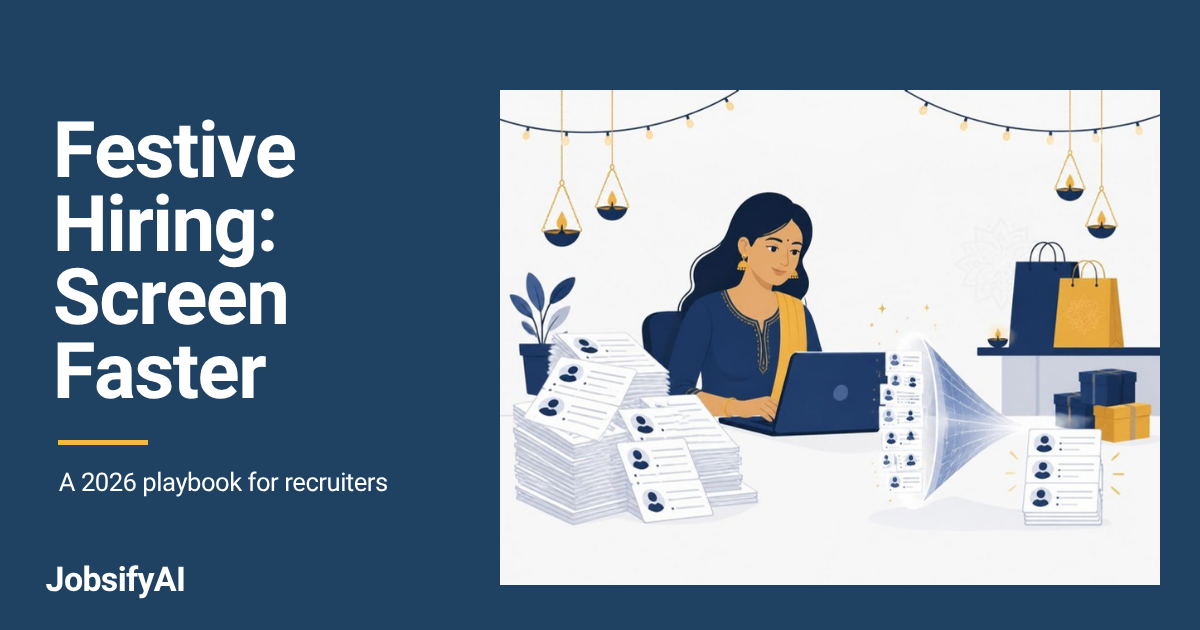
Festive Hiring 2026 India: Screen Faster, Hire Better
Jobsify AI Team · October 2, 2026
If you run hiring for a retail chain, an e-commerce operation or a customer support team, you already know the pattern. The festive rush arrives, the headcount target triples, and your inbox fills with applications you have no time to read. Festive hiring 2026 India looks bigger than usual, and that makes one question more urgent than ever: how do you screen faster without letting bad hires through the door?
This is a practical playbook for HR teams and recruiters. It covers what the latest numbers say, where most teams lose time, and the exact screening setup we recommend.
What the festive hiring 2026 numbers say
A report from staffing firm NLB Services, published on 20 September 2026, expects festive hiring to rise 15–20% and create 2–2.5 lakh seasonal and gig jobs in the second half of 2026 (Social News XYZ / IANS, 20 Sep 2026). A few details stand out:
- Tier-II and Tier-III cities such as Jaipur, Lucknow, Indore, Surat, Coimbatore and Kochi are expected to account for 45–50% of festive hiring, with 25–30% growth.
- Freshers are expected to make up 20–25% of festive hires, and hiring of women is expected to rise 30–35%.
- Ready-to-deploy talent is commanding a 12–18% wage premium.
- Employers are planning 12–14 weeks ahead of the peak instead of hiring at the last minute.
The broader picture is just as strong. In the ManpowerGroup Employment Outlook Survey for Q4 2026, 65% of Indian employers plan to add staff between October and December, the highest hiring outlook among the 42 countries surveyed (Outlook Money, 9 Sep 2026).
Put simply: everyone is hiring at the same time, from the same pool, and the candidates who are ready to start are charging more for it.
Where festive hiring actually slows down
In our experience, the bottleneck is rarely sourcing. Post a store-operations or customer-support role in Indore during October and you will get applications. The time goes into three places:
- Reading resumes that were never a fit. Wrong city, wrong shift expectations, no relevant experience.
- Phone screens that ask the same five questions a form could have asked.
- Shortlists nobody can explain. A hiring manager asks "why this person?" and the answer is "they looked good".
That last one is the expensive one. A hurried festive hire who leaves in week two costs you the hire, the training, and a replacement in the busiest week of the year.
A faster screening playbook for high volume hiring
1. Write a sharper job description before you post
Vague JDs attract vague applicants. State the location, shift pattern, joining date, language needs and the two or three skills that actually matter. Jobsify's JD generation and enhancement tools turn a rough brief into a clear, structured description in a few minutes, so you are not writing ten variations by hand.
2. Let prescreening questions do the first phone call
Most festive phone screens check the same things: can you join by a date, can you work weekends, are you in the city, do you speak the required language. Put those into the application itself. Jobsify generates role-specific prescreening questions from your JD, so the basic filters happen before anyone picks up the phone.
3. Remove friction for the candidates you want
A large share of festive applicants are freshers and candidates in Tier-II cities, often applying from a phone. Long sign-up forms lose them. Jobsify's public job board has a no-login apply flow, and candidates get WhatsApp and email updates, which is where they actually read messages.
4. Rank against the role, and demand a reason
This is where AI earns its keep, as long as it shows its working. Jobsify ranks candidates for a specific job and shows an explanation next to every score, so a recruiter can see why someone is at the top and overrule it when the reasoning is wrong. We are firm on this: AI should shorten the list, and a human should make the call. For more on the difference between real AI screening and keyword filters, read why most AI hiring tools are just automation.
5. Compare finalists side by side
When two candidates look similar, put them next to each other. Side-by-side comparison makes it obvious who has the shift flexibility, the relevant experience or the language you need, and it makes the decision easy to defend to a store manager.
6. Build a bench, not just a batch
The report's note on 12–14 week planning is the real lesson. Candidates you do not hire this week are your pipeline for the next spike. Keep strong "not now" candidates tagged and reachable, and your January backfill becomes a message, not a job post.
What this looks like in a normal week
Here is a realistic flow for a team hiring 40 customer-support associates across three cities:
- Monday: generate and publish the JD with prescreening questions.
- Tuesday to Thursday: applications arrive, basic filters run automatically, ranked shortlists with explanations update as candidates apply.
- Friday: recruiters review the top of each list, compare close calls side by side, and book interviews only with people who already cleared the basics.
The time saved is not magic. It comes from not reading the resumes that were never going to work. We have written more about that in how Indian companies are cutting time to hire using AI.
An honest note on fit
If your festive hiring is mostly last-mile delivery riders or warehouse loaders hired in hundreds per city, a gig-focused platform or a staffing agency with feet on the ground may suit you better. Jobsify is built for roles where screening quality matters: customer experience, store and category operations, inventory and supply-chain coordination, sales and team leads. For those roles, a wrong hire costs far more than a slow one.
On cost, Jobsify uses a token wallet: you pay for the AI work you use, and a failed AI call is never charged. For a seasonal spike, that beats locking into an annual seat licence.
FAQ
How big is festive hiring in India in 2026?
A September 2026 report by NLB Services expects festive hiring to rise 15–20% and generate 2–2.5 lakh seasonal and gig jobs in the second half of 2026, with Tier-II and Tier-III cities accounting for 45–50% of it.
How can recruiters screen candidates faster during peak season?
Write a specific job description, move basic checks (location, shifts, joining date) into prescreening questions, remove sign-up friction for applicants, and use explainable AI ranking so recruiters only review candidates who already fit.
Is AI screening fair to freshers and Tier-II candidates?
It can be, if the ranking is based on skills and experience rather than college names or keywords, and if every score comes with a reason a recruiter can check and override. Human review of the final shortlist is essential.
When should companies start festive hiring?
The same report notes employers are now planning 12–14 weeks ahead of the festive peak. Starting early lets you build a bench of pre-screened candidates for backfills.
Start screening smarter this season
The festive rush rewards teams that decide quickly and correctly. Post your role, let prescreening handle the basics, and review a ranked, explained shortlist instead of a pile of PDFs. See how it works for employers on Jobsify.